


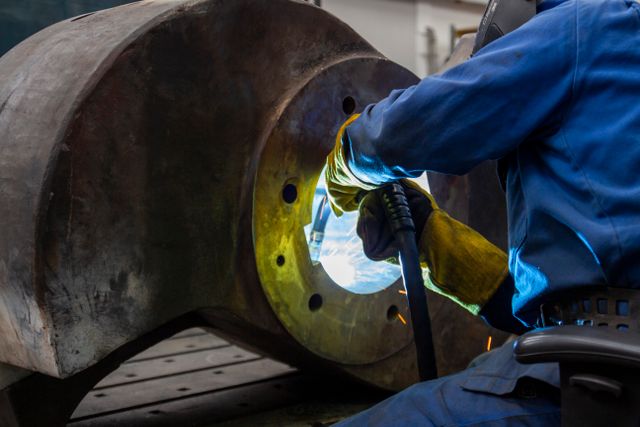
Stainless Steel suffers in fabrication because it’s tough to get corrosion resistance right after welding, it “eats away” at all that hard work. Most places don’t even do a decent job of addressing the issue.
The Real Issue With Heat Discolouration
That nasty brown and blue staining you see along a weld line, well it’s not just for show. Hidden beneath the surface, the heat from the weld has stripped away a good chunk of the chromium content. And it’s the chromium that makes stainless steel tough as nails, it creates a microscopic barrier that stops corrosion dead in its tracks. When you weld that off, you’re left with a piece of metal that behaves like plain steel, and in environments where the untreated stuff can handle anything, you’re now potentially looking at a whole lot of trouble.
Fabricators are forever focused on getting rid of that unsightly stain, which is just cosmetic after all. What they often forget is that the damage is only just beginning below the surface, and this oxidation layer extends further out from the weld than most people think. Passing that visual inspection is one thing, but if you want to know you’re really good, you need to be passing a corrosion test.
What Pickling Paste Gets Wrong?
Pickling paste was always the “go-to” for getting stainless post-weld, but it’s a bit of a joke these days. Most commercial formulations are chock-full of hydrofluoric and nitric acid, both of which are extremely hazardous to your health and the environment too. Safe Work Australia has tightened up the regulations as of late, and now all of a sudden those pesky fumes in the workshop are a lot more serious than they used to be.
Beyond the health risk, there is also a practical problem, applying paste to tube interiors, complex assemblies or vertical surfaces is an exercise in frustration and it’s notoriously difficult to get an even finish. And if you can’t get an even finish, you can’t get an even passivation, which leaves you with a piece of metal that just can’t be trusted in a corrosive environment.
Add to that the PPE requirements, the time needed to apply it all, the neutralising and cleaning afterwards, and it’s a whole lot of hassle for a product that just “aren’t worth it”.
How Electrochemical Weld Cleaning Actually Works?
Now, Electrochemical cleaning is an entirely different story. This method uses a controlled current and a conductive fluid to strip away that nasty oxide contamination and simultaneously bring back the protective layer, all in one go.
What sets this apart from traditional cleaning methods is that passivation is not something that’s done separately, it’s just part of the same process after all.
And that’s important because traditional cleaning methods are just that, they only clean the surface-level stuff off and leave the real work to happen naturally, or at least as naturally as it can in a real-world environment. Salt water, chemicals, humidity, that gap between cleaning and passivation is where the trouble starts.
But with electrochemical cleaning you get some hard numbers to work with. Scanning Electron Microscopy testing has confirmed that the chrome levels in the treated zone are actually better than the original material.
So, electrochemical cleaning is not just “restoring” the metal to its pre-weld state, it’s actually making it better than ever.
Choosing the Right Machine for Your Volume
It’s also true that not all fabrication tasks call for the same output volume. A small shop doing occasional stainless work, a structural fabricator turning out a handful of food-grade parts per month, can afford an entry-level unit. Industrial-scale stainless fabrication, constant output fabrication environments or workshops working on thick material need industrial-grade output to avoid repetitive passes and inconsistent results.
The selection of a weld cleaning machine must consider the kind of welding being done. Welds done on thin gauge materials using TIG, will require a different fluid solution to MIG welding of heavy gauge materials. Surface finish requirements play a big part; some applications will need just cleaning while others will require electropolishing capacity to produce uniform surfaces for food and pharmaceutical use.
Space available in the workshop, something most spec sheets tend to underestimate, is a practical variable to be considered. Small form factor will become critical in tight fabrication environments and mobile installations where the machine has to travel to the site and not remain on the bench top.
Fluid Selection: Where Errors Compound
After selecting the machine, it becomes easy to overlook another error many operators make when dealing with weld cleaning machines. Each stage of pre-weld, cleaning stage, neutralising, and finishing each requires a different formula. Using the same general-purpose product for all the processes leads to inconsistent results and, in some cases, the creation of residues that cause trouble later.
Fast fluids always make some concessions to speed. They are suitable for high turnover environments but not for food and pharmaceutical fabrication where any residue left behind could mean trouble during the audit process. Selecting the right fluid according to the compliance standard required not just for the speed required for each process is how shops manage to always pass audits.
To improve corrosion performance, one has to understand what weld cleaning entails. It’s not enough to know which machine and which fluid to use. Understanding the underlying process and chemistry behind it is vital.